There is a week in late September when the light changes and everyone notices at once. Mornings arrive colder than the forecast promised. A first leaf lands on the windscreen and stays there. Something registers: the year is in its final act.
It is a good moment to open the notebook with more intention than usual. Not to make a fresh start — January already has that job — but to look back honestly at what the year has held, and to set up a writing habit that fits the darker evenings ahead.
Why autumn suits a reset better than January does
January asks you to become someone else. Autumn asks you to notice who you have been. That difference matters when you sit down with a notebook, because it changes the tone of the questions. Instead of resolutions, you get a review. Instead of a blank year, you get nine months of evidence.
There is a practical advantage too. Autumn comes with built-in markers — the equinox, the first cold morning, the clocks changing, the evening you finally switch the heating on — and each one is a natural cue to write. You do not have to invent a routine from nothing. You attach a page to something that was going to happen anyway.
And the season is honest about endings. Leaves fall, the garden goes over, the light leaves the room a little earlier each week. A notebook is a good place to say plainly that some things finished this year, without turning that into a verdict on you.
Start with a seasonal inventory
Set aside one sitting of about twenty minutes. Take two facing pages — four if your handwriting is large — and give each quarter a heading:
- What grew. The project, friendship or skill that got more substantial this year, even slowly.
- What stalled. The things that went quiet. Write them down without explaining them away.
- What I carried. Responsibilities, worries, habits, the tab you kept open in your head all year.
- What I put down. Something finished, handed over, walked away from or finally forgave.
Write in fragments rather than sentences. The point is not elegance; the point is to get the year onto paper in a form you can see at once. Date the page. You will want to find it in March.
Three rituals worth copying
The equinox page
Twice a year, on or near the equinox, write a single dated page: where you are, what you are waiting for, what you are avoiding, what you would like to be true in six months. Sign it. Do not read the previous one first. In March, read September's page before writing a new one — the comparison is usually more useful than either page on its own.
The leaf list
Make one ritual physical. Go for a walk with a pocket free, collect three or four leaves, and when you get home tape them into the notebook with a line beside each: why you picked it up, or where you were standing. Journaling can become very heady. This gives the season a texture and a smell, and it takes ten minutes.
The Sunday candlelit hour
Choose one evening a week. Same chair, same drink, phone in another room, one hour. In September it is still light at seven; by November it will not be, and the ritual will be carrying itself. An hour is generous — write for twenty minutes and read for forty if that is what the evening wants.
Prompts for reviewing the year
Ten minutes is enough for one of these. Write the question at the top of a page, keep going until you run out of words, then stop. You can come back to another one next week.
- What did I do this year that I had been putting off for years?
- Which month would I happily live again, and what exactly was in it?
- Who did I see most? Who did I mean to see and didn't?
- What did I say yes to that I should have declined?
- What is the smallest thing that made a bad week bearable?
- What have I stopped worrying about since January?
- Which page from this year's notebook do I still think about?
- What do I want to be true by the first of March?
Answer two, not eight. A prompt list is a menu, not a checklist, and a notebook filled with half-answered questions is more useful than one filled with tidy ones.
Set up for a slower writing season
The habit that worked in June will not survive November unchanged, and it helps to decide that now rather than treat it as a failure later. Lower the bar deliberately: three lines counts as an entry. So does a single sentence and the date. Consistency is worth more here than volume.
A few adjustments that make the darker months easier:
- Move the notebook to wherever you actually sit in the evening, not where you think you should write.
- Keep a working pen with it. A dead pen ends more entries than boredom does.
- Add a lamp you like to the chair. Winter writing is often a lighting problem before it is a discipline problem.
- Keep a smaller notebook in your coat for the walk home, and let the proper entry be assembled from notes.
If money or work is on your mind this season, writing about it can help you think clearly — but keep the notebook as a place to think, not a place to make decisions you should be taking to an adviser.
Reread before you write anything new
Rereading is the part most people skip. Take one evening, a pencil and the last eight months. You do not need to read every page; start with the ones you remember. Mark a dot in the margin beside anything you want to return to, and a small tick beside anything you handled better than you thought at the time.
Two things tend to happen. You find worries that quietly resolved themselves, and you find plans you were excited about and then forgot. Both are worth knowing before you plan the next stretch of the year. Be careful with your past self while you read — most of us are harsher on old pages than the pages deserve.
Tonight: one page, four questions
Before the season gets busy, open the notebook, date a page and answer four short questions. Ten minutes each is plenty; a page altogether is better than nothing.
- What ended this year?
- What is still growing?
- What am I carrying into winter on purpose?
- What am I putting down before I get there?
That is the whole reset. No system, no new planner, no audience. Do it before the clocks change if you can, and if you can't, do it anyway — the leaves will be gone either way, and the page is still worth writing.
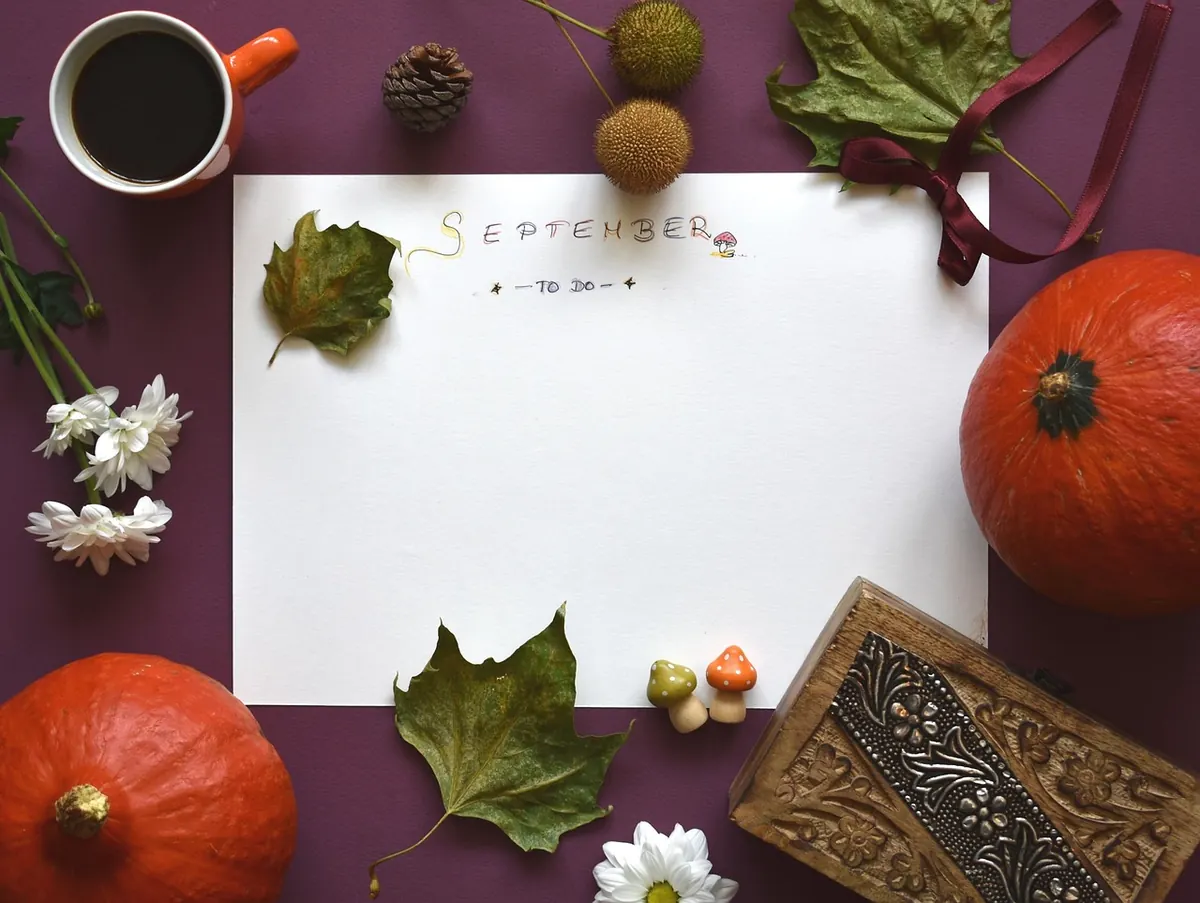
Photo: marijana1 / Pixabay